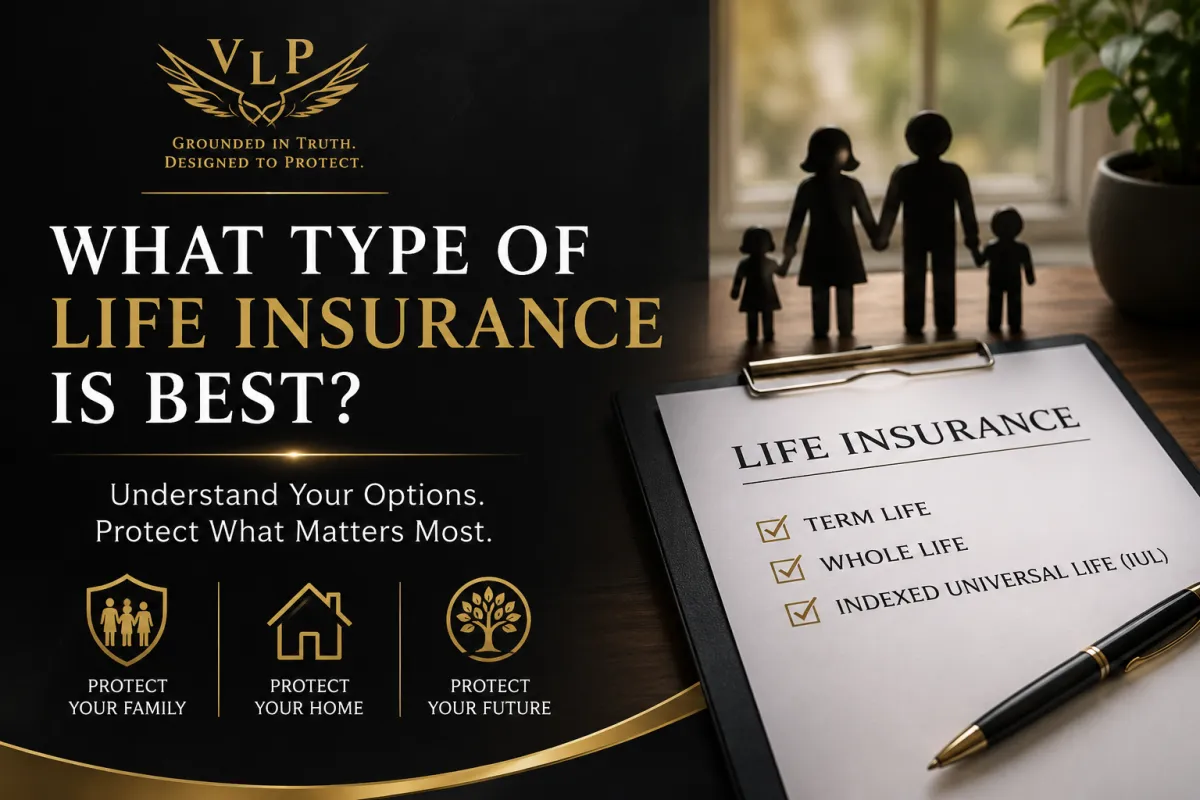
What Type of Life Insurance Is Best?
If you've spent any time researching life insurance, you've probably seen completely different answers to the same question.
One person recommends term life insurance.
Another swears by whole life insurance.
Someone else says an IUL is the superior option.
So which one is actually best?
The reality is that there is no single life insurance policy that's best for everyone. The right coverage depends on what you're trying to accomplish, what you're protecting, and how long you need that protection to last.
Before comparing products, it helps to understand the role each type of policy is designed to play.
Start With the Goal, Not the Policy
Most people begin their search by comparing policy types.
That's backwards.
The first step should be identifying what you want the coverage to do.
Are you trying to:
Protect your family's income?
Make sure your mortgage gets paid off?
Cover final expenses?
Leave money behind for your spouse or children?
Build long-term financial assets while maintaining protection?
The answer matters because different policies are designed to solve different problems.
Once the objective becomes clear, choosing the right type of coverage becomes much easier.
Why So Many People Get Conflicting Advice
Life insurance isn't a one-size-fits-all product.
A policy that makes perfect sense for one family may be completely inappropriate for another.
A young family with a large mortgage and small children often has different needs than someone approaching retirement with grown children and significant savings.
Unfortunately, many people are given recommendations before anyone takes the time to understand their actual situation.
That's why it's common to hear conflicting opinions online.
Most of the disagreement isn't about which policy is better.
It's about which policy is better for a specific goal.
The Three Most Common Types of Life Insurance
Term Life Insurance
Term life insurance provides coverage for a specific period of time, typically 10, 20, or 30 years.
If the insured passes away during the term, the policy pays a death benefit to the beneficiaries.
For many families, term insurance provides the largest amount of protection for the lowest monthly premium.
Term life insurance is commonly used for:
Mortgage protection
Income replacement
Raising children
Covering major financial obligations
Temporary protection during working years
For families primarily concerned with protecting their income and home, term life insurance is often where the conversation begins.
Whole Life Insurance
Whole life insurance is designed to provide permanent coverage that remains in force throughout the insured's lifetime as long as premiums are paid.
In addition to the death benefit, whole life policies build cash value over time.
Whole life insurance is commonly used for:
Lifetime coverage
Estate planning
Wealth transfer
Final expense planning
Long-term guarantees
The primary advantage of whole life is certainty. The structure is designed to remain predictable regardless of market conditions.
Indexed Universal Life (IUL)
Indexed Universal Life combines permanent life insurance protection with cash value accumulation linked to the performance of a market index.
Unlike direct stock market investing, properly designed IUL policies are structured with downside protection that prevents losses from market declines while allowing policyholders to participate in a portion of market growth.
IULs are commonly used for:
Permanent protection
Supplemental retirement income strategies
Tax-advantaged cash accumulation
Legacy planning
Long-term financial flexibility
Not every family needs an IUL, but for individuals looking beyond simple death benefit protection, it can be an option worth exploring.
Which Type Is Best for Most Families?
The answer depends entirely on the problem you're trying to solve.
If your primary concern is protecting your family's income and making sure the mortgage gets paid, term life insurance often provides the most efficient solution.
If lifetime protection is the priority, permanent coverage may make more sense.
If you're looking for both protection and long-term cash value growth opportunities, an IUL may deserve consideration.
The best policy isn't the one with the most features.
It's the one that accomplishes the objective you need it to accomplish.
The Right Policy Starts With the Right Conversation
Life insurance shouldn't begin with a product recommendation.
It should begin with understanding your family, your responsibilities, your goals, and your budget.
Once those pieces are clear, the right solution often becomes much easier to identify.
At Veritas Legacy Partners, we help families evaluate their options based on what they're trying to protect—not what someone is trying to sell.
If you'd like to explore which type of life insurance may fit your situation, start with a simple conversation.
Start Here: